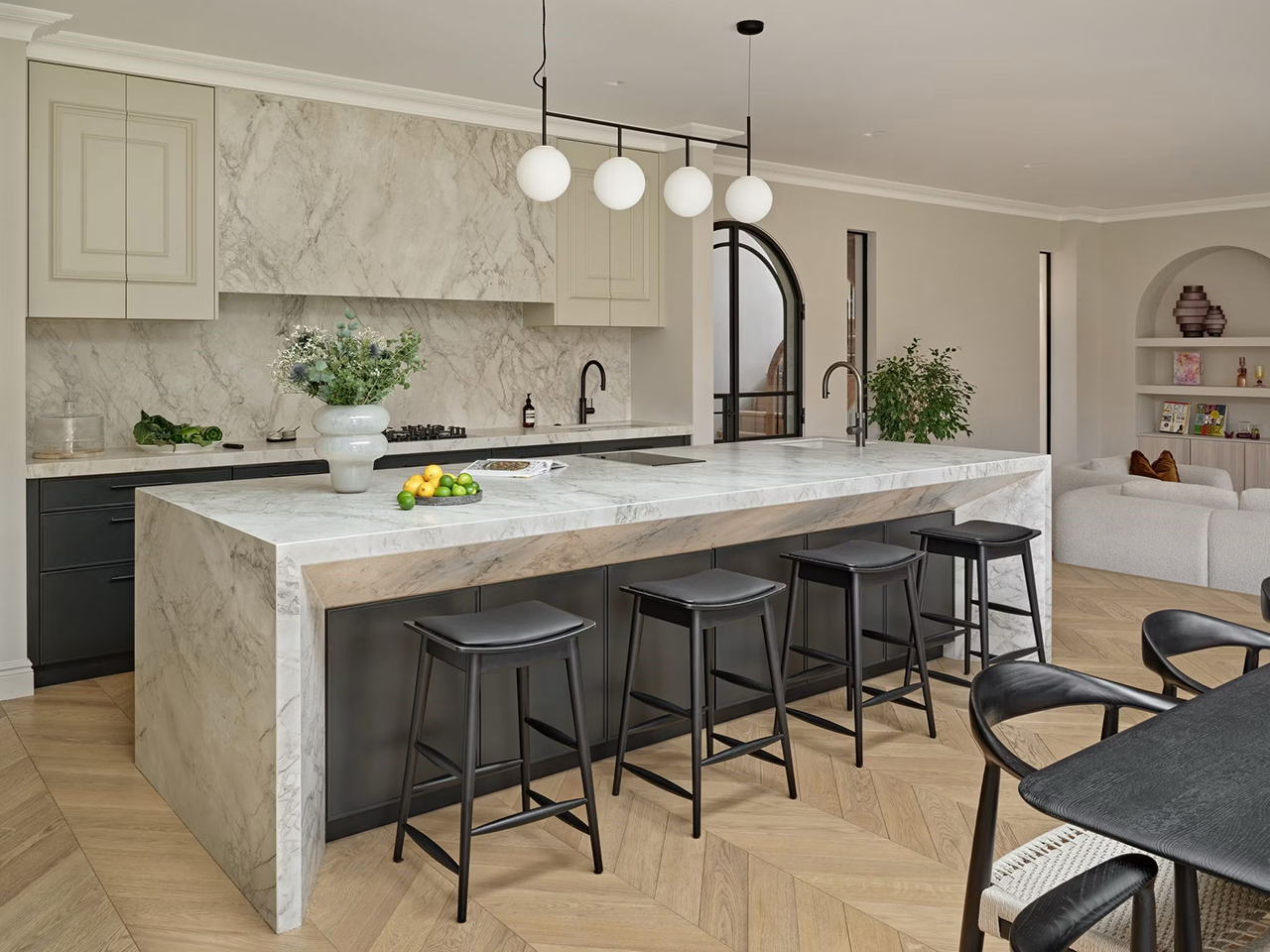
Porcelain countertops are a popular choice for luxury kitchens right now. What makes porcelain unique is that the slabs are made from natural materials fused by intense heat and pressure, with no resin binder. The slabs stand up to heat, sunlight, scratches, and stains, and their size lets a single piece stretch across an entire island. The trade-offs are a specialized installation and a premium price tag.
At Northern Building Supply, we carry Dekton by Cosentino, one of the best-known porcelain surfaces available. Here’s what to know before your design consultation.
Key Takeaways
- Porcelain countertops are sintered slabs: minerals fused by heat and pressure, with no resin binder.
- Cosentino rates its Dekton porcelain at 7 on the Mohs Hardness Scale, matching quartz.
- Heat and UV stability make porcelain a top pick for outdoor kitchens.
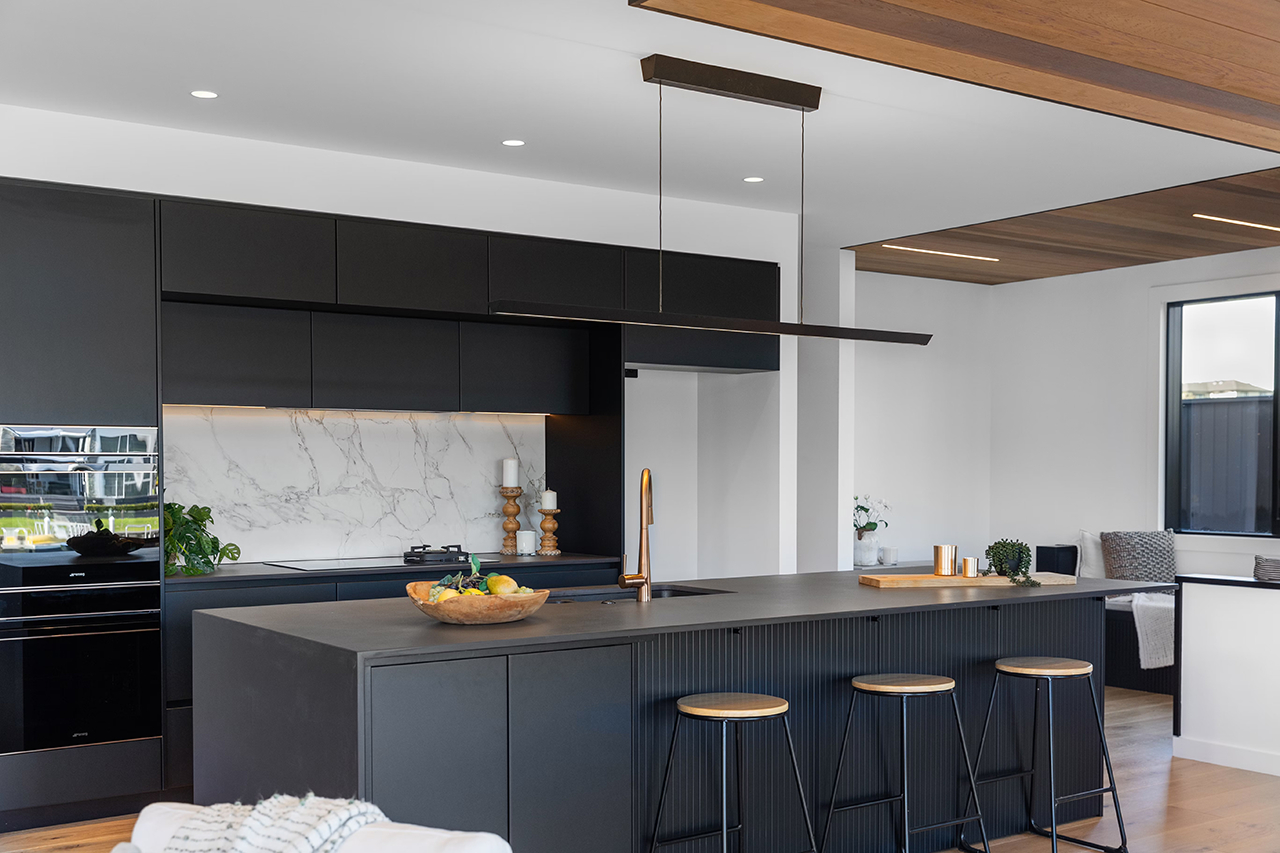
Image source: Dekton (Hayley Peterson Residential – Hayley Peterson)
What Are Porcelain Countertops and How Are They Made?
Porcelain countertops are dense slabs made by fusing natural mineral particles under extreme heat and pressure, a process called sintering, instead of binding them with resin. The result is a nearly non-porous surface that resists heat, stains, and UV light.
|
Definition: Sintered Stone A man-made surface formed when mineral particles are compacted with heat and pressure until they fuse into one dense slab. Porcelain countertops are a type of sintered stone. |
Cosentino’s Dekton description on Lowe’s says the brand recreates natural stone’s formation in a four-hour process at more than 2,000 degrees Fahrenheit and 25,000 tons of pressure.
Quartz takes a different route. Slabwise’s engineered quartz guide reports that quartz slabs are roughly 90 to 93% crushed quartz bound with 7 to 10% polymer resin. That resin is why quartz and porcelain behave differently around heat and sunlight.
Considering quartz or granite countertops? Here’s what you need to know →
What Slab Thickness Is Best for Porcelain Countertops?
Dekton porcelain countertops come in 4, 8, 12, 20, and 30mm thickness variations. The right one depends on the edge you want and where the surface will live. Thinner slabs suit backsplashes, cladding, and mitered edges, while 20 and 30mm slabs give islands a more substantial profile. Cosentino’s kitchen worktop guide notes you can pair a 20mm countertop with an 8mm backsplash in the same color and finish.
| Dekton Porcelain Slab Thickness Guide | ||
| Thickness | Best For | Good to Know |
|
4mm (Dekton Slim) |
Cladding, furniture, drawer, and door fronts | Ultra-light; confirm countertop use with your designer |
| 8mm | Backsplashes, lightweight tops, mitered edges | Use trivets for hot cookware |
| 12mm | Kitchen countertops, vanities, wall cladding | Flexible edges: straight, mitered, semi-rounded |
| 20mm | Islands, perimeter counters, outdoor kitchens | A more solid, substantial look |
| 30mm | Statement edges and heavy profiles | The most substantial option |
Thickness is a design decision as much as a performance one. For example, 8 and 12mm slabs in veined finishes suit mitered edges, which let the pattern run continuously around the corner.
Are Porcelain Countertops Durable?
Yes. Porcelain countertops are among the most durable surfaces you can specify. Cosentino’s maintenance guide describes Dekton as resistant to stains, scratches, knocks, and high temperatures, and unaffected by UV rays.
How Do Porcelain Countertops Handle Heat and Sunlight?
Very well. Dekton is designed to withstand hot cookware and holds its color in direct sun. Quartz is more sensitive: Slabwise reports that sustained heat above about 300°F can discolor quartz resin, and UV can yellow it over time. Cosentino still recommends trivets for longer contact, especially on 4 and 8mm porcelain slabs.
How Hard Is Porcelain Compared to Quartz and Granite?
Dekton porcelain rates 7 on the Mohs Hardness Scale, the same as quartz and at the top of granite’s range. Cosentino’s specifications report a 7 out of 10, and granite is typically rated between 6 and 7.
| Mohs Hardness by Countertop Material | |
| Material | Mohs Rating |
| Dekton (porcelain) | 7 |
| Quartz | 7 |
| Granite | 6 to 7 |
Note: Mohs measures scratch resistance, not heat, sunlight, or impact. Since porcelain and quartz tie at 7, the real separation shows up in resin-free construction, where porcelain keeps performing and resin-bound surfaces can struggle.
Browse all kitchen countertop materials at Northern Building Supply →
Do Large Countertop Slabs Mean Fewer Seams?
Yes. Dekton slabs measure 3,200 x 1,440 mm, roughly 10.5 by 4.7 feet, which gives a large island a real chance at a one-piece top.
The design range is wide, too. Dekton Laurent draws on Port Laurent stone, with a dark brown base and gold veining. Marble drama without the marble upkeep.
Trade-Offs of Porcelain Countertops: What to Know Before You Buy
The main downsides of porcelain are specialized fabrication, fewer qualified installers, and a higher price than most other countertop materials. Dense sintered slabs need specialized tooling; the wrong tools can break the tool, slab, or machinery.
Are Porcelain Countertops Expensive?
Porcelain countertops generally cost more than quartz or granite, and the final price depends on color, thickness, edge profile, and layout.
For context, Slabwise’s 2025 to 2026 cost guide puts installed quartz at roughly $50 to $120 per square foot and granite at $40 to $100. Waterfall edges and complex layouts add more, so a quote tied to your specific project is the only reliable way to budget.
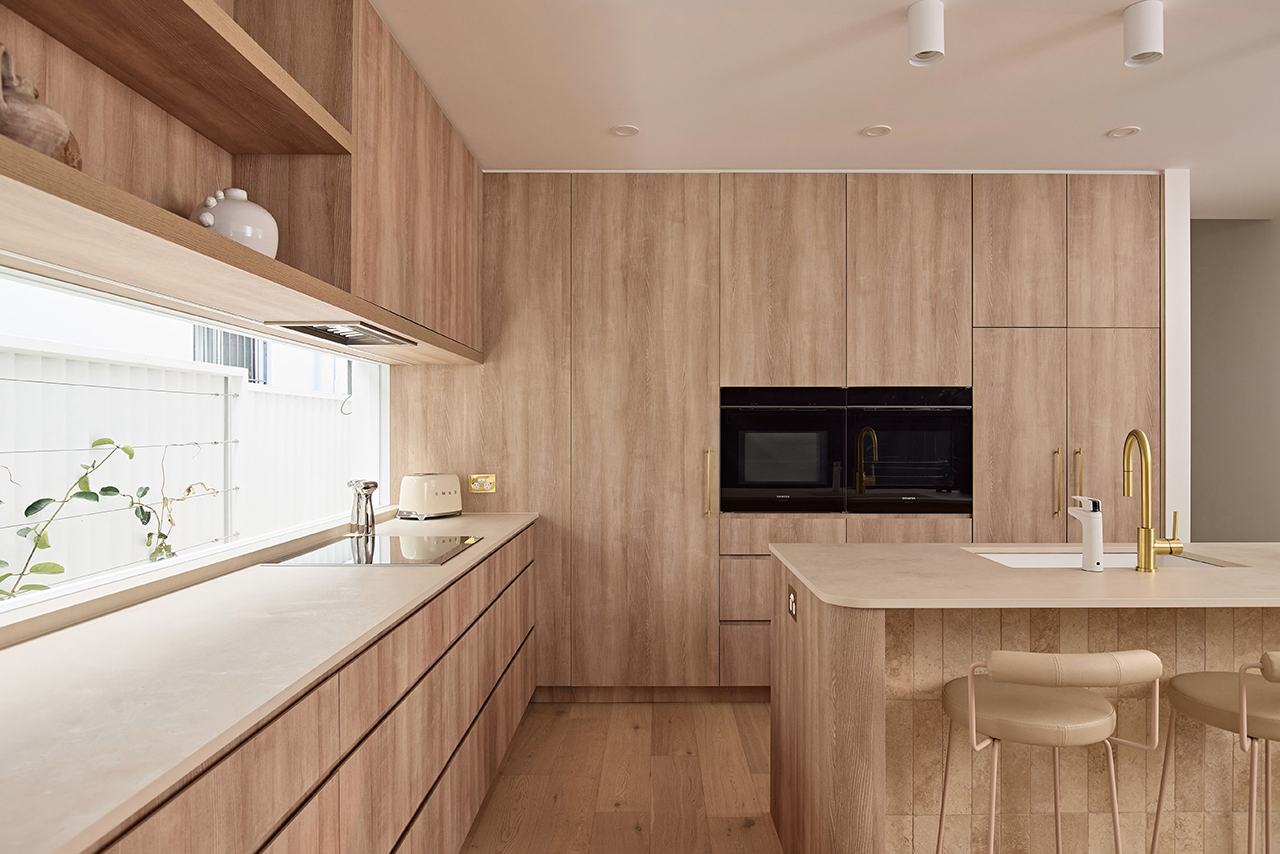
Image source: Dekton (North Bondi Beach House – Jaime Interiors)
Porcelain vs. Quartz vs. Granite: Side-by-Side Comparison
Porcelain wins on heat, UV, and outdoor use. Quartz wins on price and familiarity. Granite wins on natural character.
| Porcelain, Quartz, and Granite Compared | |||
| Factor | Porcelain (Dekton) | Quartz | Granite |
| Maintenance | No sealing; soap and water | No sealing; soap and water | May need periodic sealing |
| Heat Tolerance | Excellent; trivets for long contact on thin slabs | Good, but resin can discolor under sustained high heat | Excellent |
| Cost (Installed) | Premium; request a quote | About $50 to $120 per sq. ft. | About $40 to $100 per sq. ft. |
| Appearance | Marble, stone, and concrete looks in large slabs | Consistent, uniform patterns | One-of-a-kind natural movement |
| Durability | Mohs 7; scratch, stain, and UV resistant | Mohs 7; non-porous, but UV can yellow resin | Mohs 6 to 7; natural stone |
| Outdoor Use | Excellent | Not recommended | Good |
Quartz countertops, including Cambria quartz (also available at Northern Building Supply), remain a smart choice for most indoor kitchens. They’re low-maintenance and kinder to the budget. Porcelain earns its premium when heat, sunlight, or a statement slab is on the table.
Why Are Porcelain Countertops Trending in Luxury Kitchens?
Luxury kitchens favor porcelain because large slabs let designers carry one dramatic pattern across an island, waterfall edge, and backsplash, while the material shrugs off daily use. Design and performance work together well.
Is the Waterfall Edge Still in Style?
Opinion is divided. In January 2026, Apartment Therapy’s State of Home Design Survey found that 36% of designers are ready to retire waterfall edges as overused. Yet Food Republic’s 2026 trend coverage still names them among the year’s leading countertop looks.
The waterfall edge fades when it’s generic and lasts when the slab is the star. A distinctive colorway with movement and a carefully matched miter keeps it feeling custom, and porcelain’s large format makes that continuous pattern possible.
Are Porcelain Countertops Good for Outdoor Kitchens?
Porcelain is the best countertop choice for outdoor kitchens because it’s non-porous, heat-tolerant, and UV-stable. In Northern Michigan, where lakefront patios face full sun, summer storms, and freeze-thaw cycles, you need that all-season durability.
Are Porcelain Countertops Good for Statement Baths?
Yes. Porcelain’s low porosity suits vanity tops, and the same slab can wrap a wall for continuity. Cosentino recommends 8 and 12mm slabs for cladding, so one colorway can anchor the whole room.
If you’re looking for a more cost-effective countertop choice for your bathroom, quartz is an excellent alternative.
How to Clean Porcelain Countertops
Warm water and mild soap handle everyday cleaning, and porcelain never needs sealing. Cosentino’s care guidance recommends its Q-Action cleaner or neutral soap and water for regular cleaning.
For stubborn stains, Cosentino suggests cleaning vinegar, but glossy finishes need care: its 2022 use and care guide says XGloss surfaces can be damaged by acidic cleaners.
Where to Buy Dekton Porcelain Countertops in Northern Michigan
Northern Building Supply carries Dekton by Cosentino, and you can plan your project with our designers at our kitchen and bath showroom in Traverse City. Veining varies slab to slab, so seeing yours in person is important. Our kitchen and bath design team can walk you through color, thickness, and edge options.
Ready to price your project? Request a quote online.
Frequently Asked Questions About Porcelain Countertops
Can you put hot pans directly on porcelain countertops?
Porcelain is designed to withstand hot pans and heat-producing appliances. We still recommend mats or trivets for longer contact, especially on 4 and 8mm slabs. A quick trivet habit protects the surface.
Can you cut directly on a porcelain countertop?
Porcelain handles everyday utensil use, but Cosentino’s 2022 use and care guide advises against cutting directly on glossy finishes. A cutting board is the safest habit, since it protects both your knives and the surface.
Will porcelain countertops hold up outdoors through Michigan winters?
Porcelain is unaffected by UV rays and highly resistant to freeze and heat. That suits Northern Michigan’s freeze-thaw climate. Ask your designer about substrate and drainage details for outdoor installs.
Does porcelain look like natural marble?
It can. As of 2026, Cosentino’s range includes Rem, modeled on Calacatta Lincoln white marble. Because veining varies from slab to slab, view the actual slab before you order.