
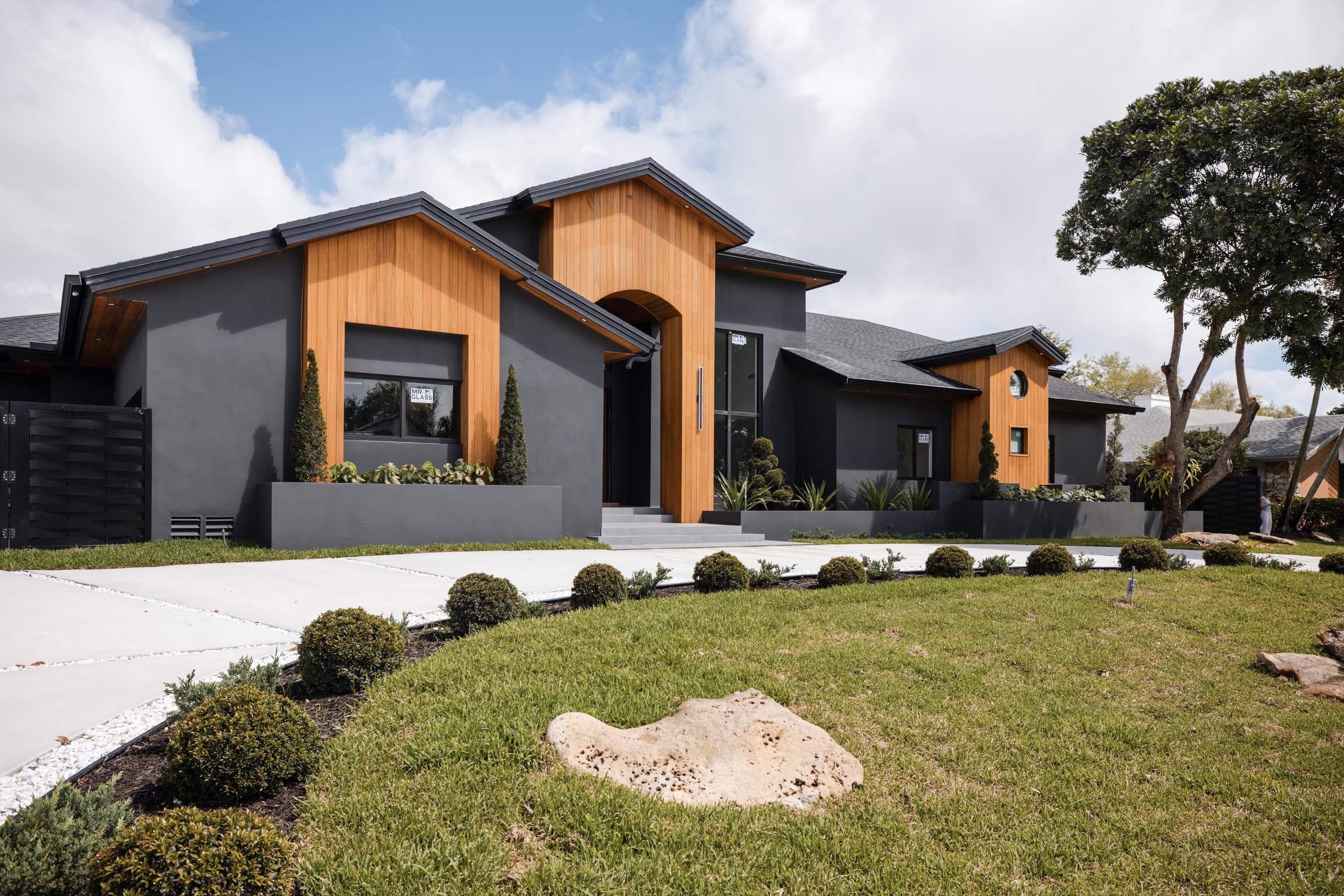
What Trim and Siding Products are Architects Specifying for Custom Homes?
Increasingly, it’s thermally modified hardwood and next-generation composites. Two products our team sees gaining steam with architects and custom builders on Northern Michigan projects are Maximo Wood and ACRE by Modern Mill.. Homeowners want the depth and grain of real wood, but they don’t want a repaint reschedule built into the cost of owning the house. That need is even more important on the lakefront, where freeze-thaw cycles and lake-effect moisture test exterior trim every season.
This guide is for architects, designers, and custom builders working through 2027 spec decisions. Learn how luxury siding and trim materials compare to traditional options, and where each one earns its place on the drawings.
Key Takeaways
- The AIA Home Design Trends Survey ranked durable, low-maintenance materials as the top growing exterior trend.
- Maximo Wood fits specs where natural hardwood grain is non-negotiable.
- ACRE trim takes paint or stain without primer and won the 2025 Pro Builder MVP Gold award.
Why Are Custom Home Specs Moving Away from Traditional Wood Siding & Trim?
Custom home specs are moving away from traditional wood trim because the long-term cost of maintaining it has become both a homeowner and builder-callback issue. In 2023, the American Institute of Architects’ Home Design Trends Survey found durable, low-maintenance materials were the top growing exterior trend among residential architecture firms.
That preference shows up in lifecycle maintenance costs, material consistency, and sustainability credentials.
Lifecycle Maintenance Cost
Painted pine and cedar trim on an exposed lakefront elevation means a recurring cycle of scraping, spot-priming, and repainting, often with lifts for second-story fascia and gable trim. Clients who’ve owned a lake house know that cost well.
Material Consistency
Clear-grade wood is harder to source in long, defect-free lengths, and even premium stock moves. On long horizontal runs and tight reveals, knots, checking, and cupping read as flaws in the design.
Sustainability Credentials
High-end clients are asking where their materials come from more and more. FSC certification, tree-free content, and formaldehyde-free manufacturing are quickly becoming expected talking points.
|
Our Experience with Luxury Siding & Trim Products in Northern Michigan Our team has seen thermally modified wood and next-generation composites gaining a lot of momentum with the architect community and custom home builders across Northern Michigan. They aren’t necessarily replacing the exterior brands builders already trust, but they are providing a new tier of options for projects where the material itself is part of the design story.
Explore all siding & trim products for Northern Michigan homes → |
What Is Maximo Wood?
Maximo Wood is a thermally modified hardwood line built for siding, trim, soffits, ceilings, and decking where natural wood character is a design requirement. According to a 2026 Building Products Digest report, Maximo Thermo is engineered for enhanced stability and moisture resistance across both exterior and interior applications.
|
Definition: Thermally Modified Wood Thermally modified wood is real wood treated with high heat and steam, without chemicals, to change its cellular structure. The process reduces how much moisture the wood will absorb, which improves its dimensional stability and resistance to decay. |
The Maximo Thermo collection includes several species with distinct grain and color profiles. The line spans Thermo Ayous, Scandinavian Thermo, Thermo Clear Radiata, and Thermo Ash, with a factory pre-finished option that gives designers more control over color and texture.
Choose a siding color for your build based on these expert tips →
What Is ACRE Siding & Trim?
ACRE trim by Modern Mill works like wood in the shop and performs like composite on the wall. That combination gives builders a trim board that cuts, mills and finishes like wood while performing like a composite on the wall.
|
Definition: Composite Trim Composite trim is a manufactured wood alternative made by combining natural or recycled materials with binders. It’s designed to resist moisture, rot, and insects while matching the profiles and finishes of traditional wood trim. |
According to Modern Mill’s ACRE trim board specifications, ACRE:
- Takes paint and stain without primer, which simplifies the finish schedule and reduces field labor.
- Cuts with standard woodworking tools and produces less harmful dust than many alternatives.
- Comes in consistent, knot-free lengths up to 20’, which keeps long trim runs clean.
- Is suitable for ground contact without sealing, an advantage for skirt boards and porch details.
- Is available factory finished in six colors across siding and trim profiles.
Sustainability is a big part of the story too. ACRE is made from upcycled rice hulls in a zero-waste U.S. manufacturing process, and it’s 100% tree-free.
It’s also earned industry recognition. In 2025, Pro Builder named ACRE a gold winner in the exteriors category of its 7th Annual Most Valuable Product Awards, selected from more than 200 entries.
|
Our Take ACRE’s biggest value on a Northern Michigan build is solving the paint-grade trim problem. Architects often want painted trim that contrasts with natural cladding, but painted wood on a lakefront site is where maintenance complaints start. Why spec a material that needs back-priming and recoating when one exists that takes paint directly and won’t rot at the ground line? |
How Do Traditional Wood, Maximo Wood, and ACRE Compare?
Traditional wood offers authenticity but carries the heaviest maintenance load, while Maximo Wood and ACRE each solve that problem from a different direction. Maximo Wood is real, thermally modified hardwood. ACRE is a wood-alternative composite designed to work and finish like wood.
Here’s how all three stack up on the criteria that matter most for custom home building.
| Luxury Trim & Siding Materials Comparison | |||
| Criteria | Traditional Wood | Maximo Wood | ACRE by Modern Mill |
| Maintenance Requirements | Regular repainting or restaining; vulnerable to rot, checking, and cupping | Improved moisture and decay resistance | Resists water, rot, and pests; won’t splinter |
| Workability | Standard tools; quality varies board to board | Standard tools; lightweight and dimensionally stable | Standard tools; no pre-drilling; less harmful dust; knot-free lengths up to 20’ |
| Sustainability | Depends on species and sourcing | FSC-certified hardwood modified with heat and steam | 100% tree-free; made in the USA in a zero-waste process; phenol- and formaldehyde-free |
| Finish Options | Paint or stain after priming | Natural weathering, field finish, or factory pre-finished options | Paint or stain without primer; six factory finishes available |
| Est. Cost | $ | $$$ | $$$ |
| Best-Fit Applications | Historic renovation, budget-driven details | Primary cladding, soffits, ceilings, decks | Trim packages, corner boards, fascia, skirt boards, siding, porch floors |
For architects comparing Maximo vs. ACRE trim and siding, the core distinction is that Maximo Wood delivers real hardwood grain with improved stability through thermal modification, while ACRE delivers wood-like workability and finish behavior in a tree-free composite. Both reduce the maintenance burden of traditional painted or stained wood trim.
Once you’ve narrowed the materials, our team can run quantities through material takeoffs and estimating, so the spec and budget line up early.
Where to Specify Maximo Wood and ACRE Siding & Trim
Specify Maximo Wood where the natural grain is the design statement and ACRE where you need a durable, paint-ready or stain-ready trim package. On many custom projects, architects spec both.
Custom Home Siding & Exterior Trim
Exterior applications are where both products deliver the most value. Maximo works best as primary cladding and soffits, especially on contemporary lakefront designs. ACRE fits the trim package (casing, corner boards, fascia, frieze, and skirt boards) and can also serve as shiplap or board-and-batten siding.
Decks & Outdoor Living
Maximo decking suits statement decks where clients want real wood underfoot, while ACRE porch floors and ground-contact trim handle covered porches and step details. Both complement the composite decking lines many custom home builders work with.
Interior Continuity
Interior use is a secondary application, but it’s a meaningful design tool. Carrying the same Maximo species from an exterior soffit through to an interior ceiling creates the indoor-outdoor continuity many Northern Michigan home plans aim for. ACRE also works for interior paint-grade casing and base where consistency matters across large rooms.
Planning a Custom Build in Northern Michigan?
Request Maximo Wood and ACRE samples from Northern Building Supply. Or schedule a spec consultation with our team in Traverse City or Suttons Bay.
Frequently Asked Questions About Luxury Siding & Trim
What is thermo wood?
Thermo wood is the common name for thermally modified wood: real lumber heated to high temperatures in a controlled, low-oxygen environment, without chemicals. The process darkens the wood through its full thickness, lowers its weight, and reduces moisture absorption. The method was popularized in Scandinavia, and brands like Maximo Wood (available at Northern Building Supply) now apply it to hardwoods for siding, trim, and decking.
Does thermally modified wood hold up in Northern Michigan?
Yes. Thermal modification reduces how much moisture wood absorbs, which limits swelling, shrinking, and cupping through freeze-thaw cycles. Maximo describes its Thermo line as engineered for enhanced stability and moisture resistance. Proper installation still matters: follow manufacturer guidance on fasteners, spacing, and ventilation behind the cladding.
Is thermally modified wood worth it?
It’s worth it when natural wood grain is central to the design. Thermally modified wood costs more upfront than standard softwood siding but needs less upkeep and moves less over time.
Will thermally modified wood siding turn gray?
Left unfinished, yes. Like most exterior wood, thermally modified wood weathers to a silver-gray patina with UV exposure. Some clients want that look on a lake house. To hold the original warm tone, specify a penetrating exterior finish or a factory pre-finished product, and plan for periodic refresh coats.
What is ACRE trim made of?
ACRE is a tree-free composite made from upcycled rice hulls, an agricultural byproduct that would otherwise go to waste. Modern Mill manufactures it in Mississippi in a zero-waste process, and the material is free of phenol and formaldehyde. The result has a natural grain texture and works with standard woodworking tools.
Is ACRE trim better than PVC trim?
It depends on the finish goal. ACRE accepts paint and stain without primer and has a natural grain texture, while PVC is typically painted and can look more synthetic up close. ACRE also works with standard woodworking tools and is tree-free.